Ask Me

“Sometime when the river is ice ask me about the mistakes I have made. Ask me whether what I have done is my life. Others have come in their slow way into my thoughts, and some have tried to help or to hurt: ask me what difference their strongest love or hate has made.”

William Stafford wrote these lines. I found his slim book of poetry on a local library shelf. I had not heard of him, and wasn’t particularly looking for another man’s musings on the state of the world. In fairness I don’t know what I am looking for these days. But I opened the book up to the opening stanza of “Ask Me.” And I promptly felt assaulted by my own shortcomings.

Is the life i have led mine? Have I allowed it to be written by the circumstances I have encountered rather than the ones I have sought? Yes. How does one realistically go about firing the ghost writer if the ghost writer is your life’s circumstances?

The mistakes I have made…do I consider them? Not often.
Do I still make them? Repeatedly. Then why have I been so slow to address them? What if the mistakes are not the main problem, only ineffective stabs at solutions?

The friends who help – what difference have they made? And before asking that should I not ask myself, ‘have I fully allowed them?’

And of those who have hurt – did I forgive them too quickly? Or did I willfully forget rather than forgive? Was this the easier path? How much does it matter?

There is community. But paramount there is self. Looking at our collectivity can be a balm but rarely does it provide an individualized answer. Unless that answer is letting go with a passivity that destroys the still unacknowledged self. That, to this old self, doesn’t feel right.

What of the wonders outside of self? I can envision Stafford’s icy river disguising the current below. Stafford confidently states “What the river says, that is what I say.” Well what does the river say? Stafford explains “…the comings and goings from miles away that hold the stillness.”

It sounds so encouragingly whole – the river contains what has come before and what will come after. But the stillness, this ice, is it not nature’s attempt to stop forward movement? I realize it is a metaphor: a seasonal pause standing in for a human recess. But isn’t the ice also a disguiser, a preventer and a cold reminder of unchangeable currents?

No need to “Ask Me.” It has literally and figuratively all been said before.

Where Everybody Knows Your Name

The first time I walked into a peer recovery center I didn’t know what to expect. A woman i had become friendly with invited me. She was leading a group called “Faith Finders” which gave me pause. That and the fact that I was not in recovery. But I had met her in a storytelling class and kept bumping into her at the gym – so her vibe seemed to jibe with my vibe. And I like saying yes to most things. So I said yes.

The meeting was held on a cold New England evening. The parking lot fronts an active harbor and nearby cars were encrusted with a thin film of ice. When I arrived I grabbed one of the few remaining seats that formed a large circle in the room. I took off my bulky winter coat and placed it on the back of my chair. I snuck a summary glance and noted that, besides the host, I didn’t recognize a single person. This was unusual since I had lived in the neighboring town for twenty-five years. I tried to refrain my eyes from making continual rounds, but we were seated in a circle – so there was no empty spot to rest them. When the introductions began each person shared their first name, followed by “I am in recovery.” As I write this, years later, I can still feel how my body responded. At first there was an initial dulling of the senses (like a baby seal taking a whack with every name call) followed by a sudden infusion of thick, unsuspecting joy. Here i was, seated among a room full of people in long term recovery. Loads of happy, healthy, community-oriented people. Who the bloody hell knew? Certainly not me – and I had been seeking the possibility of such a future for my children for over a decade.

Since then I have been back to the recovery center countless times. I have attended a breath workshop, meditation groups, and for two years a weekly parent support group. I’ve tried acupuncture. I have danced at sober rock concerts. I also scheduled one-on-one meetings with the director where I asked him the most confounding questions like “why?” and “how?” and more desperate ones like”help her” and “help me.” No matter the question, he never batted an eye. Sometimes he laughed, sometimes he shared, sometimes he handed me resources. I always left in a better head space -which is saying an awful lot.

Did you know that center’s like this exist all over the country? They do! And even though my introduction began with a group called faith finders; a recovery center is nothing like a church. Its suggested avenues to wellness are varied. On the sidewalk outside our center a chalkboard invites you to try running club, yoga, book group, art therapy. There’s even a new Ted Talk hour. You may wander in unscheduled and ask for information on how to get yourself sober, how to get a family member sober or how to deal with people who refuse to get sober.

When your children are unrelentingly sick with substance use disorder you become, or at least I became, a weird version of ‘wildy blind’ and ‘blindly wild’. Sharing the unthinkable (how else to release it from ping-ponging around your brain?) and having someone with first-hand knowledge provide clarity (yes, there can be clarity!) is invaluable. And here’s the inherent bonus: recovery centers are manned by those in recovery. Suddenly the dying dream becomes a living possibility.

Oh I forgot to tell you how that first visit went.
When it came my turn to speak I just said “Annemarie.” No re-joinder.

And everyone welcomed me.

The Ranking of Souls

Many years ago my private school introduced DEIJ exercises (diversity, equity, inclusion and justice) during one of our teacher training days. It was a fairly new concept at the time and we prided ourselves on being progressive. It was my day off so I missed the initial session. I was told it began with teachers lined up in a straight line at the far end of a large green field. Questions were asked and if answered in the affirmative you took a giant step forward.

Questions like:
Did you grow up in a two parent home?
As a child did you have food security?
Has your family remained free of incarceration/justice system?
Do you feel welcome in most group settings?
Do you identify as white?
Did you receive a higher education?
Do you own your own home?

Yeses bred more yeses – exponentially. Looking around the field it must have been apparent that a secure upbringing reaped de-facto future benefits. Of course this was the reason for the exercise.

This part of the day I understood.

Later the teachers were handed a worksheet to rank whom they would choose to live with on a deserted island. People such as carpenter, doctor, professor, captain, Gilligan. Okay, it didn’t include Gilligan – but it did include two other distinct prototypes: violent criminal and drug addict.

I was told the drug addict came in last.

Logic must have escaped my fellow teachers. Who chooses to live with someone who is violent vs. someone who suffers from addiction? In a setting without laws or law enforcement why favor the criminal? And what kind of violent criminal are we talking about? If the crime was motivated by greed can they share limited supplies? If driven by power can they live within a democratic structure? Do they have a history of destruction of private property, assault, murder or rape? Do these tendencies evaporate on a deserted beach?

In all honesty, I wouldn’t rush to choose a person suffering from substance use disorder (SUD) either. The scientist, the boat builder, the storyteller – they have obvious benefits. But the person with SUD wouldn’t be last. Admittedly they can be violent: but it’s nearly always in pursuit of their drug. (Which, hello, makes it a non sequitur on a deserted island!) It is also true that active drug users are inconsistent contributors to a functioning society. But active addiction requires access to a drug.

At the time these exercises occurred my teenage daughter was in prison for her addiction. I was angry upon learning of my fellow teacher’s decision making process. It seemed curiously uncaring for a group of progressive educators. And if statistics ring true nearly every one of them knew someone suffering from the disease of addiction. Did they not believe in recovery? Could they not see the human inside? I understand the “eyes wide shut” response. Maybe they didn’t want to look too closely. And then there is the daydream of many a worn out caregiver: life on a deserted island! On this island we never bring our problematic family. We are alone, reading a book, tilting our noses to the welcoming sun.

I considered the human tendency to dislike in others what we dislike in ourselves. Many of us struggle with over-indulgence, keeping our word, consistency, making permanent lifestyle changes. So maybe it was as simple as not wanting to look at themselves.

I am not sure. I will never be sure. It’s too late now to go back and ask. And I don’t know if people would be honest with me. But I do know I was left with a vision: my daughter moving backwards across that green field; like a chess piece being cleared from the board. Thoughtlessly removed when she could still bring so much to the game.

Waiting for Death

Death is the end of living.
All those biological processes – stopped.
It’s hard to imagine the blood stopping its circuit, the neurons no longer firing.
It’s easier to imagine the cessation of familiar parts of being –
No more rising belly breath, silly rambling thoughts or winter hands in need of warming.

It’s possible to imagine this in myself because I know my body, I know my age, I know the constructive and deconstructive properties of time and nature. I am nothing if not rational.

But death is not welcome to touch my children.
And what does one do if they dance with him continuously?
If they are not rational? If they do not value their youth or listen to reason?


Seriously, I am asking you: what does one do?

Yet Another Eulogy

My daughter called me last night. The phone was filled with the sounds of blind, depthless sobbing. I will not forget the sound anytime soon.

Her friend had been found dead. Her former roommate. Someone she spoke with and texted daily. A week prior she had marveled at this woman’s ability to still be “trusting to a fault and ridiculously loving.”

Someone, like her, who was trying so bloody hard to get to that better place.

I don’t care for the saying “they are now at peace.”
They may be. But we should not be.
Let there be peace when we all have a fair shot at obtaining it.

My daughter took half a day from work. She curled up with a migraine and threw up for a few hours in her darkened bedroom. And then she got up. She went back to work caring for the thirteen other women in her sober home.

If there is a eulogy I hope it foregoes words of peace and instead honors the struggle. An exhausting struggle that can only be endured with ridiculous amounts of love. And even then, many don’t make it. It’s hard to find peace in that.

Hippy-Dippy Drug Days.

Do you remember when the local drug dealer was the high school kid with the chalk-painted Camaro who smoked during math class? Or maybe it was the friend twice removed who would set up lines of coke in shiny bathrooms of boom-boom-boom nightclubs? How about the neighborhood kid who rode his bike around town to deliver a mishmash of badly rolled joints? You would think to yourself, “Jesus Christ, am I the only one who knows what is going on around here?!”

Upon reflection, it really was kind of quaint. I am not trying to make light of drug dealing; but it was simple. It was local. It was a much naughtier version of the farm to table movement.

The latest way for teen’s to acquire drugs is through the snapchat app. Snapchat’s mascot is a small ghost: “now you see me, now you don’t.” Rather than being a cute play on peek-a-boo, it is meant to highlight the disappearing nature of texts. There is no paper trail, no electronic trace, no phone record…nothing to help you deduce why your child is writhing on their bedroom floor in a drug induced psychosis. Or worse yet, not even moving. This is a big problem for parents, and an even bigger problem for law enforcement.

One thing is certain: kids are still going to experiment. So absent a time machine, what are we supposed to do?

First, acknowledge the difference.

I have heard many parents say “It’s a rite of passage…I did it too in high school.”‘ Umm… no you didn’t. Marijuana in the 60s had a THC content of 2%, in the 90s it was 4%. Today’s weed is 200% stronger. THC derivatives like dabs, oil and shatter can contain THC content north of 95%.* Sadly, the higher the THC the lower the CBD content, and CBD has been shown to mitigate damage caused by THC to the brain’s hippocamus.** So if you are a reformed teenage pothead think twice before assuming your child’s brain is undergoing the same neurological “fun-fest.”

I am also surprised that parents willingly serve underage kids. Their justification? Learning how to “handle alcohol in my house is safer than the alternative.” But there is nothing safe about sharing alcohol with teens. Today’s research has proven there is a link between early drinking and a lifetime of addiction. We didn’t know it back then, but we know plenty about brain science now. We also know that parental disapproval is the number one reported reason teens put off drinking.*** (So why blow that safety measure?) Yes, some of us safely snuck a few beers in high school; but it’s important to realize that todays teens disproportionately binge drink. (Sadly, in my highly educated town, 17% of high schoolers reported binge drinking within the last 30 days.) Kids also have access to higher alcohol beers and very quaffable “fruit punch” flavored hard seltzers. Most of them have easier access to cars. It’s not as rosy as adult memories may suggest. So why romanticize it?

And let’s return to that teen smoking marlboros next to his camaro. It’s now a vape pen. Vape pens may not contain tobacco but they are still highly addictive and still contain cancer causing chemicals including VOCs, Diacetyl and formaldehyde. And realize that, just like marijuana and alcohol, our kids are getting “more bang for their buck.” A single e-cartridge is the equivalent of an entire pack of cigarettes. And they can be discretely smoked right in class – teachers can’t even smell them! Thanks big tobacco for developing a product that helps our kids avoid detention and comes in so many delicious fruit flavors!

For God’s sake the playing field is not the same.
So let’s stop saying it is.

* National Institutes of Health, National Library of Medicine, PMID: 30643324
** Harms, Protection and Recovery Following Regular Cannabis Use, pub.med.gov PMCID: PMC5068875
***NIAAA.NIH.Gov: publications/brochures-and-fact-sheets/make-a-difference-child-alcohol

Group Ghost Buster

Groups exist: running clubs and bird watching clubs, weight watcher groups and book groups. People join because of a common interest or to encourage each other in a common pursuit. But did you know that some people willingly join groups they do not want to belong to?! My husband and I belong to one. We joined a support group for those who have a family member suffering from the disease of addiction. We joined because “life had become unmanageable” and changing the behavior of our child was not possible. Instead we learned that we, like the others, are powerless. The common thread that binds us is pain.

Most Sundays a new face appears. We sit in a circle and each member gives an update on their addict; they are “doing well or back at rehab, homeless or paying rent.” We also share personally; we are “questioning our decisions, learning to not overreact, tired but hopeful.”

Why do we do this? There are therapists, on-line forums and self help books. There is also denial. Why meet to discuss the difficult?

I am not sure. But people tend to join when they are in crisis. The first step in the door is often a desperate one. They come for advice on what to do about a “missing family member high on alcohol and cocaine” or a loved ones positive tox screen for “benzos, fentanyl, crack and amphetamines.” We listen. We nod. There is a lot of nodding. There are no solutions. Instead we offer gentle suggestions or a new way of looking at the problem. It is strangely comforting to realize our ugly experience may be helpful to another – at a minimum by making them feel less alienated. A magical sort of alchemy happens when both hurt parties end up feeling a bit better.

When it is my turn I get to speak aloud the fears that have been echoing endlessly in my head all week. I liken this to opening up my closet door and calling out the ghost. Group Ghost Buster! My three-day headache dissolved after I shared one week. Why did the ibuprofen not work? I do not know.

You know what else helps? Getting lost in looking at my fellow group members.* I like looking at their shoes, their hands, their eyes, their hat choices. One wore pajamas two weeks ago! Some bring dogs. Some bring knitting. Others sit confidently. Some curl up a bit. I find it comforting to get lost in the visuals of our collectivity. Who knew this would be our reality? It’s akin to being dropped onto a strange new planet and having to assess your new mates. My husband’s verdict is that “he has never been in a room with more kindness and empathy.” I think he may be right. One member recently checked in with me via email. He signed off “you are loved.” (I cried then, and I am crying now.)

Ultimately, being in a group like this makes small talk impossible. Instead you must reach down to a deeper level to share the stuff that keeps us all afloat. I guess I should have nicknamed us Group Soul Buster. I encourage you to join one if you are in need.

*We now meet virtually. But I look forward to our in-person gatherings: for the shoes…and the hugs.

Public Service Announcement: Pressed Pills.

Pressed pills are counterfeit pills. And they are everywhere. If you are unfamiliar with them than you and I had something in common. We have all read about cash-only pill mills run by pain clinics. And individual crimes committed by those feeding an addiction: raided medicine cabinets, falsified prescriptions, doctor-shopping and faked injuries. But prescription pills no longer need to be hunted down because counterfeit ones can be delivered right to you. It’s an incredibly lucrative business. Consider that in the first seven months of 2020 the Minnesota DEA confiscated 46,000 counterfeit pills. That computes to 80K pills a year – in Minnesota – hardly a state known for its drug activity! If we were to use that same number and conservatively apply it to all 50 states, 4 million pills would have been confiscated. 4 million. Keep in mind that the police can’t find them all. Odds are there are upwards of 20 million illegal pills flooding our streets every year.

And most of us know nothing about it.

So what is a pressed, or counterfeit pill? They are pharmaceutical imposters made by drug dealers instead of lab technicians. They look exactly like the real thing in color, size, shape and feel. They even mimic the imprint code found on authentic medications. They look so real police are routinely fooled; unless you are transporting buckets of them in the backseat of your truck you are going to get by just fine – even if pulled over and asked to turn your pockets inside out.

But here’s the bigger problem: they are not what they purport to be. Pressed Adderall is comprised of methamphetamine, crack and speed; Xanax of ammonia, rat poison and fentanyl and Ecstasy of ketamine, bath salts and morphine. They may not be what you were originally shopping for, but they will get you high; and in doing so flood your bloodstream with highly addictive, highly deadly, substances.

How are they made? With a simple $500 investment on a pill press and pill mold. Equipment that is easily found on the internet. The profit on such an investment is six figures.* It’s no wonder it’s a burgeoning underground marketplace.

It’s seriously depressing. It is so monumentally hard to get ahead of the illegal drug trade. When one door closes (cutting back on the over prescribing of legal meds) another one opens.

I think back to a party I attended in 1984 at Vanderbilt University. I was a freshman experiencing my first frat party. It was wild. The music was blasting and the rooms pulsated with purple light. A few men wove their way through the crowd carrying large silver trays littered with pills. Pills of every color and size – free for the taking. I stuck to my beer. But plenty of others picked from the tray.

Here too one can get seriously depressed contemplating the ever widening scope of the problem. Yes, those pills pose a danger to those actively seeking them, but also to those who do not.

Richard Salter of Omaha’s DEA agency warns, “Please educate your high school and college-age kids on the extreme dangers of counterfeit medications, too often the overdose victims are young and are not prior drug abusers. They went to a party and someone offered them a pill to relax them – then they died. Too many American parents have had to bury their children as a result of drug overdose.” **

And so you have it: today’s public service announcement.

*March 2019 NABP, NADDI, and PSM
** DEA, Press Releases 8/12/20

*March 2019 NABP, NADDI, and PSM
** DEA, Press Releases 8/12/20

Summer Porch

I have come to my summer porch to take in the late afternoon sun.
The old porch is hexagonal and has two squeaky wooden doors, two ripped screens and a weathered mahogany floor.

In one corner I spy a robust little pile of mouse droppings. They betray a foolishly circuitous trail; a rodent’s version of the Hansel and Gretel tale.

Under the small wrought iron table I find two soft grey feathers. Feathers like those from the breast of a grey catbird. They lie discarded, side by side.  I can’t help but hope that she didn’t struggle too long before finding her way back through the opening in the ripped screen.

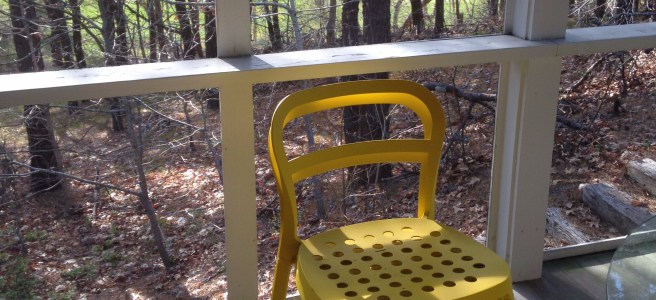
Around the old iron table sit four bright yellow chairs – one of which has a long black hair entwined tightly around a securing strut.  Was it yanked from the head of the person because they rose too quickly? How long has it been there?  Why do I not remember having a visitor with such long black hair?

And as I write this an electric green dragon fly encircles my big toe.
I want him to light down on my blue painted toenail. My mind silently chants “do it, do it, do it.”  He chooses not to heed my psychic call.

So now I turn my gaze to the hummingbird feeder. I have filled it with sweet sugar water in just the right enticing ratio. But no one has visited yet this year.  I used to have a visitor. He would frequently hover just inches from my face. We would study each other. The sound of his frantic wings would fill my ears and I would worry about the short distance between his beak and my eyes.  But it was always thrilling.

I googled Mr. Hummingbird’s repeat visits. It had to mean something, right? What I learned was that Native Americans believed a hummingbird was sent as a reminder to live in the moment.

I can see now that I have both missed moments and tried to control moments. And I am still doing both. I came here not to witness mid-summer beauty, but to distract myself from my preoccupation with wishing for another’s wellness. The nagging truth is that a wish, no matter how badly one wants it, does not create reality.

How can such a lovely thing, a wish, be also such a sobering thing?

As I write this I realize I have not learned a thing.  I flex my painted toes and scan the yard.  I am still waiting for that little green hummingbird to visit me again.

Paper Airplanes of Love.

Everything is a love poem.

Someone said this recently.
I think they were joking because their tone was a bit flippant.
But after he said it he let a long pause hang in the air.
And the pause felt like a challenge.

I guess I would like to believe that everything is a love poem.
I admit I embarrass myself. Am I just a silly girl?

Yet there is a whole lot of love tucked into nearly every day: A smile from a stranger, the cat that follows you down the driveway, the extra cheese someone put on your sandwich, the feel of the wind on your cheek, an evening swim, a pink sky, music on the radio, cold ice in a drink, the feel of a warm embrace. Right now my big old red dog is laying down under a tree and sniffing the air. If he catches me looking at him he will feel the need to come stand by me, and in doing so he will have to move his arthritic hips. I look quickly away so he will not struggle. Love, love, and more love.

Of course we can’t dismiss the broken hearts, the divorces, the deaths.
Yet these hurt because they showcase another side of love: the loss of it, the memory of it, the importance of it.

Then there is self love. Contrary to what our media feed may tell us self love is not a day at the spa or a healthy meal delivery from an internet box service. True self love depends upon unconditional love.

The first time I considered the meaning of “unconditional love” was after a text from our family therapist. She implied that I might have been lacking it. She sent it upon the aftermath of my umpteenth midnight run to pick up my screaming daughter from a police lock up. The therapist was wrong. Nothing my child did or said could have made me love her less. I was just not willing to equate loving her with letting her go. I was not willing to “live and let live.”

Sometimes I criticize myself for all the time spent “loving” her – often at the expense of the other members of my family, and my own. (If you think you are hard on yourself ask a mother of an addict how she feels deep down inside.)

I had a fabulous therapist for a year who asked the most ridiculous questions: what kind of wild animal did you see today? what is your love language? But she was also spot on. She brought me back to the love that was all around me (that old dog under the tree, that cheese on my sandwich, that pink sky).

Unconditional self love, however, is a strange concept. We misinterpret it. We think a self improvement regimen is as an act of self love. Or we recite our strengths to feel worthy of it. But self love requires something completely different. It requires accepting that mountain of other, quieter, stuff; our operating quirks, our bias, our mistakes. That mountain grows as we get older. Maybe that is why so many of us address it later in life.

My New Year’s resolution is to take time to sit quietly.   To sit quietly atop my mountain of stuff.  And I am going to write some love poems.  And I am going to let them fly.

Blue Puzzle Pieces.

I was watching a pretty horrible rom-com movie the other night that had one redeeming moment. It was when the female told her heartbroken friend that he was ‘broken apart like a puzzle and needed to search for the blue pieces.’

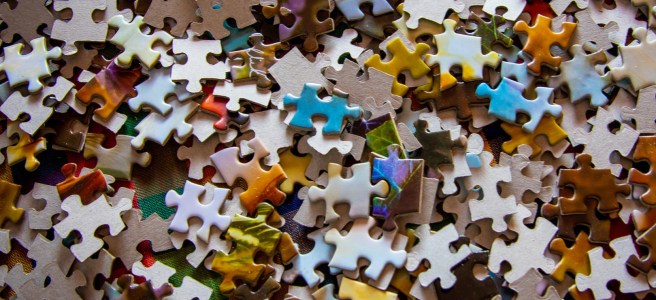
Now this seemed like pretty bad advice. Putting together a puzzle involves seeking and creating distinct subject matter piles: the farm house, the feathers, the tractor. The blue ‘filler’ pieces, like the sky and the ocean, are chosen last.  (Why would you eschew the obvious for the nebulous?)  Clearly the puzzle comment was a metaphor; but was she actually advising her friend to find himself by looking outside himself?

I thought of my daughter. In recovery she has found success looking outside herself for stability. She has learned that arranging and re-arranging, ruminating and re-assessing the pieces of self is not always productive. Turning her attention to something bigger, something out there – like the sky – can be the best anchor there is.  It becomes an intangible you can neither wrangle with nor second guess.  You can rest in its remote vastness.

She often sends me pictures of the mountains she climbs. And the rivers she runs beside. And I download these photos to my iPhone. I look at them occasionally – they have become my blue pieces.  I feel this is both wrong, and right.

We spend a lot of time as mature adults concentrating on the subject matter of our lives; paying for and tidying the concrete spaces we have built. When we find time to consider the blue pieces – how often do we notice if they are truly our own?


Time is Not Golden.


Broken things can be mended. Like my coffee mug with the reattached handle. And my old cashmere sweater with the stitched moth holes. Broken things can also just be broken. Like my refrigerator which is currently leaking all over the kitchen floor.

You probably know where this is going. This is a blog about recovery after all.

I like to remind myself that broken things can be fixed. I am sitting at a round oak table that I found in the bowels of an antique store. The owner practically gave it to me when I said I liked the shape of it. I brought it home and stripped it, sanded it, stained and polyurethaned it. It is heavy and beautiful and has the most glorious curled feet. For so many years it sat in the basement of that shop covered in green paint. You couldn’t even see those strong, lovely feet.

But recognizing an objects worth and fixing it are sometimes not enough. The motherboard on my refrigerator has been replaced yet the temperature continues to rise. I defrosted a frozen drain hole and the ice block returned.  I superglued the fraying rubber gasket – it ripped some more.

People can be broken too. But unlike objects, people are not irreparably damaged.  Yes, some may have been born with “operating quirks.” Some continuously fall prey to their own bad choices. And some peoples broken-ness can be blamed on others.

The Japanese term for embracing imperfection is called “wabi sabi.”  I like this philosophy; I find delight in crooked teeth, aging faces, scarred body parts.  Who really wants airbrushed perfection?  But admittedly some things are not just worn, but broken.  The Japanese have a solution for that as well:  kintsugi.  Kintsugi is the practice of using gold joinery to reattach broken pottery. Gold joinery to illuminate imperfection!  The resulting pieces are a work of redemptive art.  Like my round table.  Like the people I have met in recovery.

But how come some people never make it to that redemptive place? I believe it is simply a matter of running out of time. The time needed to be pulled out of that “dark basement,” the time needed to have their broken-ness acknowledged, and the time needed to reassemble themselves.

Today I am thinking of all the lovely people who ran out of time.  When I was little my father would ask me “what kind of wings would you like when you become an angel?… gold, silver or copper?”  (Disclaimer:  my dad never believed in Christianity. He was most likely drawn to the Pre-Raphaelite imagery.)   I always answered copper. I preferred the warm shimmer.  

I know this is a silly wish – but if there is a heaven, I hope that when I arrive the golden wings are reserved for the broken people – the ones who either fixed themselves while on earth or were mercifully repaired when they ascended.  Kintsugi Angels.  

Amuse-Bouche


An amuse-bouche is a single, bite-sized hors d’œuvre. You do not order it. Instead it is chef chosen. A single earthy escargot. Tuna tartare wrapped in a crispy beet slice. An heirloom cherry tomato filled with lemon infused goat cheese. You get the idea: a tiny surprise that packs a big punch.

Amuse-bouche: it has a nice ring to it. It’s advantageous to have a fancy pants word in your back pocket for use at corporate back-slapping parties and such. But its use is kind of limited. And it’s a shame to have a good foodie word go stale. What if we applied it in a broader sense?

A successful amuse-bouche is more than a single yummy morsel. It’s a clue to the ‘taste direction’ of the rest of the meal. It’s basically the “divining rod” of the unfolding culinary experience.

What if we asked ourselves what small moment, or amuse-bouche, has predicted our life’s path thus far? It can’t be a moment we were responsible for; like choosing the late train home and inadvertently sitting next to our future spouse. Instead the moment has to have been presented to us. A tiny morsel that, if we were paying attention, forecasted the unfolding of future events.

If you had asked me a few weeks ago what my amuse-bouche had been I could have come up with a half dozen. It might have been how my youngest daughter did not like to be held close when she was an infant. Instead she liked the isolated confines of her car seat. In response I took to putting her in a snuggly every evening and walking up and down the streets of our small town with her firmly affixed to my chest. I figured it was a way to give her the best of both worlds. This small moment now appears a microcosm of our larger struggles; hers to uncomfortably retreat and mine to forcibly show maternal love.

I might also think back to how she wanted to fill her crib with large plastic toys – rocking horses and dump trucks. I would ably assist: You want this one? You want this one? She would grunt and nod and only lay down her head when she was nearly buried alive. For the next twenty years i would become a witness to her unconventional, and frightening, methods to self soothe.

Another “amuse-bouche” could have been her night time ritual. Instead of singing ‘twinkle, twinkle little star’ she would tick off a long list of potential disasters on her tiny little fingers. With her eyebrows stitched tightly together she would recite “house fire,” “tornado,” “molly-dog dying.” When I would ask her to please stop she would insist on continuing because “if she said them out loud they would not happen tomorrow.” It was like watching her conjure up the prop gun at the beginning of a movie. The prop gun that always portends disaster. As adults we know there is no wishing away the bad stuff.

But none of these were my true amuse-bouche moments.

I learned this after hearing a friend speak uncomfortably about her down syndrome sister and the family burden it had created: their father abandoned them and her mother became consumed with her care. This friend smiled recalling how she and her sister would play simple card games over and over and over. She didn’t recognize that her “amuse-bouche” had not been the birth of her sister. The card game was. The words “over and over and over” were the clue – they highlighted what was to become her signature strength: patience and empathy.

Her story was a reminder that our amuse-bouche moments are not the big things. They are not the burgeoning substance use disorders and the undeniable disabilities. They are much quieter, much more subtle. A chef would explain that it is not the oyster itself – but the taste of the brine.

I know now what my amuse-bouche has always been. It was the kindness shown to me by my eldest child when she was just a toddler. I had been lying in my bed, crying. It was nothing more than new parent exhaustion. But she got herself up from her nap and toddled her way down the hall to check on me and with her little hand on my back she gave me tiny pats. And then she offered her pacifier to me.  She was comforting me the only way she knew how.

How could I have nearly forgotten that one amazing moment?

An Augusten Burroughs Kind of Dream.


I had a strange dream last night.  In this dream I tried to help someone (a confident yoga teacher) find something in a dark basement. I ran after him to help because I knew it would be very dark and very dangerous down there. But he shut the door on me. And I was left behind in a room full of beautiful, happy, healthy people. It was then that I felt the arch of my foot throbbing. Refusing to acknowledge the pain only led to it increasing and traveling to the top of my foot, my ankle and my calf. When it became nearly unbearable I looked down to find swollen blackness had encased my lower leg like burnt elephant skin. I recall thinking, “This is okay. You can handle this by ignoring it some more.” Just then a partygoer with a handy pair of scissors grabbed my leg and started cutting the damaged encasing away. I was semi-terrified but decided to trust them and was surprised to feel no pain as the damaged skin fell away in sheets. I watched as my leg emerged – pale, healthy and pain free.

I think I know what this dream is about.
It’s about opening my eyes to the constant need to close them.
It’s about learning to let others fend for themselves.
It’s about cutting away the things that bring me pain (not to be confused with ignoring things that give me pain!)
It’s about trusting others to help me.
It’s about re-claiming space with the happy, healthy people.

This is the perfect sort of dream for a mom of a child in recovery to have.

It’s funny how our subconscious sends us freaky night time missives and our waking mind attempts to make sense of them. Of course I can read this dream many ways. Possibly I should be more humble – who do I think I am that I can help an athletic male yogi avoid danger? Or maybe I am simply being reminded to run a little less so my foot doesn’t throb in my sleep.

Or possibly my brain is sending me the naughty subliminal message to get in with the type of people who run with scissors.

🙂

“ACE” made me do it.

There is a relatively new addiction model called Trauma Therapy. One of it’s chief proponents, Dr. Gabor Mate, explains that people are born perfect and adverse childhood experiences (ACEs) create trauma which leads to addiction. In an interview in The Fix Mate claims, “if children receive conditions of love and respect in their childhood, they’ll never be addicted, they’ll never get depressed and they’ll never be anxious.”

What qualifies as an ACE? Physical, sexual or verbal abuse, physical or emotional neglect, living with a parent who is abused or addicted, having an incarcerated or mentally ill caregiver, or suffering the loss of a parent through divorce, death or abandonment. The Centers for Disease Control developed these markers to identify people at high risk for obesity, depression and addiction.

According to Mate all IV drug users score positively on the ACE scale. Furthermore he insists if you do not recall childhood trauma then you are repressing it and in need of extensive “trauma therapy.” (If this is not a siren call for false memories then I don’t know what is.)

I shared my doubts with a follower of Dr. Mate. I explained that my child did not meet a single marker on the ACE scale. Stymied, they asked if her childbirth had been traumatic (which felt a bit like “mother blaming”). When I explained that she was the easiest of my childbirths I was told my daughter must be a victim of epigenetics. This was explained as “inheriting on a cellular level the trauma of previous generations.” I was then asked if something ugly could have happened to me as a child, something that I may not even recall. A subconscious molestation could be the reason I birthed an addicted child.

This does not sound like responsible science to me.

Epigenetics is the science of gene expression. It explains how the environment may turn on/off the expression of certain DNA coding. For example there is scientific evidence that extensive stress can cause permanent damage to the body’s production of cortisol. This makes sense since we are biological beings and our bodies interact with, and are affected by, our environment.

The proponents of an epigenetic basis for addiction cite work done by Rachel Yehuda Ph.D., at the Icahn School of Medicine. Dr. Yehuda hypothesized that genetic damage suffered by an individual could be passed down to future generations. She deduced this after finding an increased rate of anxiety, depression and obesity in the children of Holocaust survivors. She attributed their health problems to inherited faulty cortisol production and enzyme regulation; rather than asking if growing up with PTSD-affected parents could have produced an environment that fostered stress in the children.

It is important to note that Dr. Yehuda’s work has been debunked. The Chicago Tribune (citing various sources) reported “Yehuda’s study began with too small of a study size. Only 32 survivors and 22 of their offspring were studied. That’s a very small group on which to base this theory and a major study flaw.” The article further revealed a major flaw within Yehuda’s research: “While the team studied the children of women who lived through the Holocaust, they would have to study the great-grandchildren of survivors to prove actual epigenetic inheritance from mother to offspring. Why must four generations be studied? The eggs that made you were present inside your mother when she was a fetus inside your grandmother. Because a pregnant woman already possesses the DNA of her grandchildren and these genes can be affected by things during her pregnancy, the DNA of the great-grandchildren has to be studied to show that epigenetic changes were passed on across generations.”*

I also can’t help but think that if generational trauma was a prescription for drug abuse the species would be extinct by now. The circle of damage would have increasingly widened as generations multiplied exponentially through time.

Strict reliance on ACE is problematic on another level: it rigidly shuts the door on other causes of addiction. Purdue Pharma flooded the market with highly addictive pills that have been proven to change neuro-pathways in the brain. Are we really going to insist that those who got addicted did so because of early trauma (divorced parents possibly?) and not because they were the victims of corporate greed?

Interestingly Mate acknowledges that “not all of those who have ACEs become addicts, but all addicts have ACEs.” Why isn’t Mate questioning this discrepancy? Could the difference be attributed to the fact that some people are genetically predisposed? Or that they have less emotional resiliency because of a psychological disorder that is eased by substance use such as anxiety, bipolar, or depression?

Dr. Mate insistence that psychological disorders are created by early trauma is nonsensical. Babies are not born perfect! Every day children are born deaf, blind and lame. They have congenital heart defects, they have sickle cell anemia. To think that the newborn brain is inure to imperfection is ridiculous.

Imperfection is part of nature. I often ask my art students to go outside and find the perfect tear shaped petal, the perfect circular rock. They always come back empty handed and we marvel at the impossibility of it. It is only the foolish or megalomaniacal who dream of perfection.

My daughter is flawed – but not any more than me. She is stubborn, I am prideful. She is anxious, I have self doubt. She did not have a traumatic childhood; she had a fairytale one lived out in a house near the sea with a sister, a brother and a big fluffy dog. She tells me nothing untoward occurred during her formative years and I believe her. Can she benefit from trauma therapy? Of course. But it would be for trauma experienced while using.

Mate’s proposition is maddening because it is reductionist. And because it asks people who are already suffering to seek another layer of pain where none may exist. It also demands that science take a back seat to a condition that people are finally beginning to accept as a disease.

I feel traumatized by the possibility of it.

Stats… STAT!

Our children relapse. We are warned “relapse is part of recovery.” But I don’t think most of us believe it. By the time your child has a few years under their belt you get comfortable. You see a person emerge that you haven’t seen in years. Someone who is genuinely happy. Focused. Funny. Confident. Surely this person is here to stay.

But the fact remains. A mom I know confessed to returning to the days of sending canteen money to her son after his recent relapse landed him back in jail. She ended her dark missive with “why, why, why?”

It’s a rhetorical question I suppose. We know why. Giving up anything for a lifetime is a pretty monumental task. Giving up something you once loved more than life itself must be harder. Then throw in the added bonus of having an addictive personality or a mood disorder. Those are some pretty good whys. Sometimes I am amazed at the fortitude required to obtain 2-3-4 years of complete sobriety. It feels like a miracle. But I don’t want to think this way. I don’t want my daughter’s future to be dependent on a miracle.

Last week my daughter called me from detox. It was her third attempt in ten days. Her voice was hopeless as she numbly reported “only 1% of addicts ever make it mom.” I also have heard this number quoted. And I don’t like it.

We know statistics are manipulated to present a particular point of view. Is this one in existence because historically we haven’t cared enough to get the math right? Or has it been cultivated to justify poor spending on treatment?

This number was ringing in my head when I sat on an opioid forum last week. Beside me sat the head of a Massachusetts hospital emergency room department. He confidently stated that “involuntarily committing addicts to treatment is not recommended because we are setting them up for a higher rate of overdose death.” I am presuming his reasoning was based on the premise that this population is not interested in quitting drugs and therefore would return to using. I don’t question that deaths are higher among the involuntarily incarcerated vs. the voluntarily committed when treatment ends. It makes logical sense. But the data is flawed. The data is flawed because of “patient selection bias.” The doctor failed to include those who were NOT included in the data: those not forcibly committed to treatment. I venture to say that most of them are dead – or will be dead. Look at it this way: it’s like playing Russian Roulette with people who don’t want to quit the game. If you take away the gun some may eventually go back to playing with the gun. But if you DON’T take away the gun… well everyone is going to die. It’s that simple.

Are there better stats regarding relapse? Unfortunately there is a dearth of long term data. One of the few long term NIH funded studies followed 1,162 addicts for eight straight years. Published in the Journal of Alcohol and Drug Abuse it revealed that as the length of time in sobriety increases, so do the odds of continued sobriety. Those with less than a year have a 33% success rate. Those with over a year increase their odds to 50%. And those who achieve five years can expect an 85% future sobriety success rate. Data just doesn’t exist for those with 20 or 30 years of recovery time; but those who work in residential centers find their reappearance rare.

So we know clean time breeds more clean time. I remember joking a few years back with a local officer.  I asked him to handcuff my daughter to her bedroom radiator to prevent her from scoring. He smiled, but then seriously replied “yeah, I can’t do that…and neither can you.”

Since that day I have been searching for a legal means to success.  That searching even led to attendance at a spiritually based reading group (disclaimer: it is an act of desperation for me to turn toward faith for any sort of answer.)  What I found was that many of those in attendance were living a life of successful sobriety.  History, science, and society have not been kind to those suffering from the disease of addiction so we can not blame them for remaining in the shadows.  AA and NA use “anonymous” for a reason.  But by sharing their status this group become a living example of hope and, even better, a room full of positive odds!

It is still going to take a lot of unbiased research to get us solid numbers to stand upon.  Faulty statistical analysis, unfunded federal research, a lack of evidence-based treatment, and social stigma have led us to this unsettling place. To live within the world of addiction is to stand on shaky ground.

For now I will tell you what I can do. I can share a whole new set of facts with my daughter when I visit her at the hospital. I can tell her with confidence that the 1% success rate is inaccurate. And I will tell her with even more confidence that she matters 100% to me.

These are the only true numbers at my disposal and, for today, we are relying upon them.

I Am Never Tired.

I am never tired.
I am consumed by the what-ifs.
A 100 pound mother in boxing gloves with starry eyeteeth.

You can not tell me to let it die.
I will not let it die.

My furnace is stoked with yesterdays newsprint
dirty fingers licked by white sleeves,
silver smoke smothering all rational thought.

But rational thought is a white flag,
and I am a-boil in shaky embers and the bluest of ash.
I am aware that we are both a-simmer
vein deep in illogical warfare.

But I will not accept the prophetic precision
with which you stick your self made kewpie doll.
Make no mistake this is a race
Desperately filled with
red poppies, red poppies
ground into artificial blood.

But I will not be detracted from my stoking,
gathering tiny fairy twigs and discarded birthday ribbon.
I am a swollen bonfire
belching a message to the sky:
There will be no scorched earth today.
No more clotted dirt and darkened eye.

I am so very, very busy.
You see this fire, your fire,
I will not let it die.

Rainy Beach Day.

Exactly two years ago I wrote these words in my journal:

Sarah is still clean.
It is a miracle.
Others are dying though. Dying everywhere at an unprecedented rate.
But we all die. I think about this at the beach and I cry with relief.

I think about these words. I don’t remember writing them.
Was I crying because my daughter was safe?
Or was I crying because death is our shared destiny
– and how can you fear something so natural?

I don’t know.

Today my daughter is safe after her relapse.
But today I do not feel relief.
Maybe it is the rain. Or the wind signaling the end of summer.
Or maybe it is something internal that I just can’t access.

It could be fear for the future,
or stress over the uncertainty.
It could be sadness for her struggle,
or anger at my being unable to fix it.

It is probably all of these things.  And more.  I know there is more.

One thing is certain though – today I will visit the beach.

The Art of Telling Stories.

I recently joined a storytelling troupe. This is a weird one for me since I don’t like being on stage. No one would ever describe me as theatrical. But this particular group shares recovery stories. Wishing to ‘end the stigma” I felt a moral obligation to sign up.  Plus, let’s face it, I have a lot of ugly stories in need of a facelift. Quite possibly this group could help with that. And there was a selfish reason; I was searching for people whom I could talk to. I’m not a recluse; I have some pretty awesome, long-term friends. But the whole friendship thing gets complicated when your child suffers from addiction. Most of the time, your friends just don’t ask. I had been forewarned ‘when your child suffers from a disease like cancer you get cards and casseroles, but when your child suffers from addiction you get silence.’ I found this to be true. Five years brought me one card, and no casseroles. Occasionally I did get to share my experience… but the exchange became too lurid even by my standards:

Mom #1: “X can’t seem to pass his driving test and he is so depressed. I worry about his self esteem.”

Me: “Y is sleeping in a filthy motel forty miles away using type A narcotics. I can’t sleep at night worried that she may be dying as I lay here in my beautiful bed.”

You can see the problem.

So you end up alone with your thoughts, either by choice or because people don’t want to engage in this kind of exchange (how are they supposed to respond?) But if not careful your sense of isolation can fester into a wound of resentment. You can’t help but wonder what friendship is really for. You start to feel buried alive: your once perfect family is now dysfunctional and your friends are psychologically absent. It can be a dark place to find yourself in.

This time when my daughter relapsed I decided things were going to be different. I considered asking for what I needed. But I just couldn’t do it. It felt like asking someone to love you… pathetic and powerless.

Instead I opened myself up to new avenues of expression. The arts take Courage and Power (uppercase letters intended). I am going out on a limb here… but I would venture to say that the definition of good art is that it is emotionally complex, it inspires conversation, and that it accesses the buried but universal elements of human nature.

As suspected it wasn’t easy to stand up in a room full of strangers and entertain, inspire and heal with a broken hearted story. One teller spoke of a day when she had sat at a table littered with jittery tinfoil scraps and the small rocks of crack she had been hoarding. She describes her apprehension when a strange man decides to sit opposite her. When he offers her a little blue pill to help her come down from her teeth clenching high, it is not the free pill that takes her by surprise. It is the impossible blue of his eyes. Suddenly the drugs became secondary to basic human connection. I could feel my head nodding. Connections can be made in the most difficult of environments. And the truth is that those who say you can “do it alone” are either misguided or lucky enough to not have been in too dark of a place.

One of the last storytellers spoke sadly of the loss of her marriage and self control to drug use. And of her dad’s steady effort to take her on long daily walks. On stage she mimic’d how her father, on these walks, would steal long wordless glances her way. It was all she needed; to be fully seen and quietly loved. To be fully seen and quietly loved – it is the only thing any of us truly need.  Life had taught me this.  And the arts gave me the means to express it.


Angry about (t)HAT.

I can’t help being angry about “HAT.”  HAT is the acronym for ‘heroin assisted treatment.’ A vocal minority is currently pushing for the legal prescription of heroin. Yes, you read that correctly. Before your head spins on it’s axis, consider that the aim is a noble one: ending death by overdose. Lives should be saved because the prescribed heroin would be pharmaceutical grade; not tainted by fentanyl, carfentanil, or any of the dozens of additives and poisons that can make up a street purchase.

HAT isn’t the brainchild of businesses trying to cash in on a future market (like WeedMaps, a California based online marijuana dispensary which is funding pro-marijuana lobbying groups in Massachusetts). Nor is it coming from those seeking lost tax revenues or the end of illegal street dealing and the crime that accompanies it. Instead it is voiced by those whose opinion should be highly valued: former addicts.  And by addiction counselors whose only motivation is saving the lives of their clients.

Disagreeing with such individuals gives me great discomfort.
But I feel strongly that HAT would be a mistake.

Prescribing heroin to an addict feels like giving up on them. (Would we prescribe bottles of vodka to an alcoholic so they wouldn’t drink antifreeze?)  These substances are KILLING them.  The ugly fact is that those who suffer from addiction are not going to quit until their life becomes unmanageable. Unmanageable may never come if we hand them their poison. The counterargument would be that HAT is successful in the Netherlands, Germany, Canada and Portugal. But they measure success by the decrease in deaths by overdose. You may have less death, but you may also have less recovery.  Isn’t recovery the goal?

Besides the ethical implications, there are practical ones, What sane physician would prescribe heroin? I can hear the counterargument: doctors have been happily prescribing oxycontin for decades so why stop now? While it is true that some willfully ignorant doctors bear partial responsibility for the opioid epidemic, most were deliberately duped by Big Pharma’s false claim that oxycontin was non-habit forming. Then, as an added blow to responsible prescribing, insurance companies tied doctor compensation to patient pain management (thanks again to Big Pharma’s funding of fake focus groups). But the past is the past and I can’t imagine finding a nation of doctors willing to prescribe what they should not have been prescribing in the first place.

HAT will have its supporters if the movement gets off the ground. One of them is certain to be the insurance industry. Did you know that heroin costs $5 a bag? On the other hand Vivitrol, a medication which blocks the effectiveness of heroin, costs $1000 a month. Which do you think your insurance company would rather cover?

I bet Big Pharma will also sign on for HAT. Why not get the green light to repackage oxycontin as heroin and continue to profit from the misery of others? I feel like smashing my t.v. on a daily basis when I see Purdue Pharmaceutical marketing their new pill Symproic to help opioid constipation. The joke is most certainly on us.

Possibly the biggest obstacle to prescribing heroin may be the addict themselves. As my daughter confessed “enough is never enough.” Will we have to continually increase the amount of heroin we prescribe as their tolerance increases? And if we do not will they trade their prescription for fentanyl laced street dope? My child told me that many addicts seek out fentanyl for the higher high. Let that sink in.

There is a saying that “if we could ‘love’ our addicts to health there would be no addicts.” There are so many of us out here, right now, seeking a quicker, better, safer solution. I know of a parent who drove their child to purchase heroin, waited in their car fitfully until they returned, and then watched them inject it because they needed to test positive for detox admission. Can you imagine being that parent? No one, no one, wants to be that parent.

Legally prescribing heroin….it feels like being that parent.


God Moments?


Someone in recovery described a story of mine as a “God moment.” They didn’t mean God, per se. They meant those moments when the universe just seems to be there for you. One of those rare times when the “dots get connected” when you least expect them to.

The moment I had been sharing was hardly ‘heavenly.’ It was about the time when my seventeen-year old daughter had prematurely left drug treatment and gone missing. A tip on her location had landed me in court to have her arrested and involuntarily committed for treatment. The judge issued a warrant that was due to expire at the end of that very day. As I sat on the court bench and waited for her arrival I had a distressing front row seat to a slow parade of sadness, ugliness, and desperation. What I did not witness was the arrival of my daughter. (A year prior police escorted her in both hand and leg cuffs. There is nothing more shocking than seeing your child shackled this way; other than realizing a year later that you are now looking forward to those same custodial restraints.)

With one eye on the ticking clock I asked the court officer for the address to the local police station. Upon arrival I informed the officers that I was about to “do their job for them.” They warned that my efforts would be wasted since ‘no one would open the door in a drug den.’ I countered that it was much more likely my daughter would answer if she heard my voice and, regardless, I was going whether they came with me or not. Possibly shamed, but more likely legally bound, they agreed to accompany me. That was when I learned that the neighborhood was so dangerous that a second cruiser was needed. To top it off I was given a lecture about “staying behind the officers” when we entered the building. (No God moments thus far… instead It felt a bit like we were prepping to enter the fifth level of Hell.)

The address led us to a street that was a lifeless shade of grey. There were dozens of people milling about but they morphed, understandably, into silent watching shadows. The triple decker we approached was adrift in discarded clothing, empty cans and bits of unidentifiable metal debris. The front door was located on the second floor and had no discernible way to reach it. No staircase, no doorbell, no mailbox, no buzzer. Together we rounded the building and discovered a dirty basement door boarded over with plywood and nails. I envisioned prying it open and crawling through the darkness. I made a note to return to this door if need be. Rounding the last side of the building we were greeted with an entry level, dead bolted, door. And a woman. The same woman who had been silently watching us from across the street. Earlier I had thought she was a man. But now I was close enough to make out the large breasts that hung to the left and right of her plain cotton tee shirt. She was powerfully built in denim jeans and construction boots. She had a plain round face, and a long thin black pony tail that hung down her back: pencil straight. Her countenance was unreadable. She pointed to me and, wordlessly, pointed to the third floor. I replied “yes.” She nodded and turned her attention to the large brass key ring on her hip. Methodically she flipped through dozens of standard cut keys and selected just one. And she opened the door. The next few minutes were a bit of a blur. I know we climbed to the third floor and we knocked and my daughter answered. The officers put her in handcuffs and she was wild with spitting fury. Even so, the officers carefully tucked my daughter’s dirty blonde head into the back of their cruiser. Before following them back to the courthouse I sat in my car for a moment. I didn’t notice that the woman had approached my driver’s side window until I heard the knock. Rolling down the window she spoke her first word to me. “Drugs,” she said. I nodded. Staring hard at me she then said “Bad drugs.” I replied, “yes.” Then she said, “good mamacita,” and slowly crossed the street.

It was only then that I remember feeling truly overwhelmed. Unhinged may be a better word. I had been playing this game for a few years but this feeling was different. I rolled up my window, but not without the self correcting thought “this is what you do in neighborhoods like these.” Yes, this is where my daughter was lost. But this is also where she had been found. Someone – someone I never expected to help me – had done so. The police hadn’t. What if she hadn’t been there? What if she didn’t have those keys? Why did she help me when she knew there was drug activity going on in a building she obviously had some sort of responsibility for? Why had she helped me in front of the cops? Was it a gift from one mom to another?

It was, in the end, a coming together of disparate parts of the universe.

Of course I felt unhinged. I don’t know if I experienced a God Moment. I don’t even know if there is a God. But I am beginning to believe I may have met some sort of fallen angel. A fallen angel who was working hard on our behalf. A fallen angel in construction boots.

.


Sthira vs. Sukha

Sthira and Sukha are popular yoga terms meant to convey a “yin and yang” sensibility. I think of sthira as “roots” and sukha as “wings.” A more accurate translation of the Sanskrit would be “stability” vs. “lightness.” When practicing Ashtanga yoga I have always sought the sukha, or the potential to fly. I sometimes giggle aloud when my feet release skyward or my heart floats up to the ceiling. It is such a rare treat to escape gravity’s pull.

Sthira, however, is quite different – in many cases it requires the engagement of the larger, lower, muscle groups (the quads, the glutes, the abdominals). For two weekends now I have been reminded that stability is key. Scot, our instructor, has had us feel our feet, bend our toes, challenge our inner and outer thigh muscles…he even put us in cat pose and had strangers balance their bodies atop us in a form of improv contact. These undulating movements required constant shifting of my center of gravity in order to take someone else’s flight – or to entertain my own.

I thought I understood: ground yourself before you take off in flight!

Once again, I required re-direction. I overheard Scot explain that being actively grounded allows the upper body to be consciously free. “Active” being the key word.  Do not rest in your present position – but fully feel it for what it is (whether it be crooked floorboards, the push of another body against your spine, or the outward turn of your imperfect feet.) By doing this you are not actively seeking flight or lightness of being. You are instead grounding yourself to the earth and thereby engaging an interior reservoir of strength. Only then will your body feel safe enough to bravely reach upwards.

That is when the lesson sunk in. I have lived this lesson. For years I tried to create and recreate stable, safe footing for my daughter who suffers from addiction. I bounced between “Maybe I shouldn’t have said that. Maybe I should have said this. Maybe I missed something developmentally. Maybe a new school will work. Maybe a new friend circle. Maybe a new therapist. Maybe a new medication. Maybe exercise. Maybe more consequences. Maybe less consequences. Maybe a different insurance plan. Maybe, maybe, maybe….” I left no rock unturned. I needed her, us, to be free. But sukha was nowhere to be found.

I remember the moment when I finally accepted our situation. I was driving and the sun was setting and and my whole sense of being was flooded by the fact that my daughter had relapsed again. I didn’t know how to be. How could I just be with this? I remember breathing and releasing into that moment with a complete acceptance of the truth. It was dusk and the sky opened up before me and I thought, “this.” There is “this” too.

This acceptance, which I still feel vaguely uncomfortable with, was a long time coming. I had to fully acknowledge that change may not be possible – at least not in this present moment. This is not an easy thing for a mother to fully feel. But once I did I noticed the sky. It sounds so cliche – but at that moment I was fully awakened to the incredulous sky. I also understood this to be the second part of Scot’s admonition: to be consciously free. I chose to see the sky.

Since that day, nearly three years ago, I have looked upwards and found something akin to flight. And, incredulously, for two years my daughter has stood on terra firma.

We are free.


I Wish I Could Be A Better Person.

I have seen addicts become better people than you and me. Those previously deemed selfish, sick, irresponsible, lost, criminal, hopeless.  Pick an adjective – at one point they all fit.  I know this sounds like pure hyperbole.  And to clarify, I don’t mean better than their old selves – that is obvious.  I actually mean better than you and me.

You and I, presumably, are the definition of good people.  We try to do the right thing on a daily basis. We live the Golden Rule.  But at the end of the day we close the curtains on the larger community.  We choose to be with just ourselves or the nuclear family we have created. We retreat to safety, comfort and self.

But the recovering addict doesn’t do that.

They often choose to mentor those who are still suffering severely – with little concern for the temptation that may present.  In the Big Book it is referred to as “giving back” or Step 12.  They claim that it helps themselves – but this, I think, is an overly generous sentiment.

I liken their behavior to that of a person surviving a fire… and then becoming a fireman. I don’t know about you, but I would never be that brave.

When those we love truly beat their addiction it can be hard to recognize them.
And it can be humbling to see that they have surpassed us in their ability to love and empathize.

For example, my daughter shares an apartment with three other individuals in long term recovery.  Their lease has expired, and two of them have decided to buy a home and possibly marry.  But even though this couple is ready for life’s next big step – they will not leave the other two women behind.  One could rationalize and say they are bringing them along to help pay the rent.  Until you learn that they are narrowing their house search to homes that can access the bus line.  My daughter is the only one of the four that does not have her driver’s license.  Purchasing a home within walking distance of public city transportation is of course more expensive.

And then there was the lesson I was given on Christmas day.  I had told my husband I wanted a pair of earrings made by a local artisan jeweler.  I wanted any color but blue – because, lucky me, I already had so much blue!  On Christmas day I opened my gift… and they were blue.  My face fell.  I didn’t hide my disappointment.  I even said “Ohhh… but they are blue.”

My daughter looked at me and said “but they are beautiful.” And later she said “Mom, you should have been grateful.”  She was right.  I had put my feelings (not needs!) first in a matter as trivial as that of material abundance.

I can’t imagine living every day weighing my psychological, financial and material needs on an equivalent basis with the larger community.  I had thought the Golden Rule was enough.  But the Golden Rule is based on seeing things through your own eyes – treating others as you would like to be treated.  But how about getting the “you” out of it?

Becoming a better person is within reach.  I know this because I have learned it from the recovery community.

I See You Mr. Double Standard.

I know many people believe that healthcare dollars should not be spent on those who choose to use street drugs. I get it. It’s about personal responsibility. Healthcare dollars are stretched enough caring for those who aren’t the agents of their own destruction.

However, I ask you to consider the following:

We cure cancer in those who continue to smoke cigarettes.
We staple the stomachs of those who ignore the food pyramid.
We perform heart surgery on those who have never seen the inside of a gym.
We given insulin to those who knowingly eat donuts.
We fix the broken limbs of those who practice extreme sports.
We pay for the delivery  of babies conceived by high risk mothers.
We stitch back the bodies of those who crash speeding cars.
We treat melanoma in those who refuse to stop sun worshipping.
We treat venereal diseases in sexually promiscuous people.

The costs incurred for treating these examples of “irresponsible behavior” are staggering: According to the Centers for Disease Control and Prevention, smoking is the number one preventable cause of disease in the United States and it costs $170 billion dollars a year in direct medical costs. According to the American Diabetes Association one in three medicare dollars are spent on treating diabetes at a cost of $322 billion dollars a year. And, “American use of tanning beds may lead to upwards of 400,000 cases of skin cancer annually.” (American Academy of Dermatology).

But you know what?  Those individuals receive treatment with care, efficiency, and efficacy. The same can not be said for those with substance use disorder. This time a year ago my nineteen-year old was turned away from a detox center because there were no beds. She then walked to Boston City Hospital’s emergency room, sweating and trembling, for help. They too turned her away. Desperate, she spent that evening trolling Mass Ave looking for the drug she needed to tide her over for one more day. The next morning she returned to both the detox center and the emergency room. And once again she was refused admittance. She called crying; “could I please, please help?”

Help should have been as simple as a request.

I spoke with the ER doctor. He explained, “we don’t treat drug addicts here.” He then explained that he would also not admit her for mental health reasons because he didn’t believe she “would kill herself.”

I felt weak at the knees. How does one mount a spirited defense when powerless?

“My daughter is only nineteen years of age. She is not yet a hardened street addict. She is high on a drug that is killing people at an unprecedented rate. She is asking for help. You are that help.”

Silence.

“We are not asking for charity. She is insured by two separate policies.”

His reply: “Hospital rules do not permit admittance.”

“Surely,” I argued, “it is time for hospital rules to change. This is an epidemic. Turn her away and there is a strong possibility that she will die tonight.”

Silence.

“Why wait for the hospital to change it’s policies in response to a dead child and a lawsuit?”

Silence

“You took the Hippocratic Oath.”

Silence.

“You could lie about the reason for her admission…”

Do you know how it feels to beg when you shouldn’t have too? Begging when the stakes are so ridiculously high?  It feels like swimming against the tide while trying to reach your drowning child. Swimming and swimming…and then the dorsal fin appears.  But hope is not lost: a lobster boat comes into view!  You yell for a rope. But they don’t throw one.   No, they don’t.  Instead, they sit back and watch.  Because, you know, she shouldn’t have been swimming in those waters.

I know I sound angry. That’s because I am.  I spend $1500 a month out of pocket for health insurance – and I have had to beg for life saving services.  Addiction is classified as an illness by the Diagnostic and Statistical Manual of Mental Disorders (DSM-III).   But the double standard most assuredly remains.

Triggers Are Not Real.

“TRIGGERS ARE NOT REAL.”

My daughter stated this, firmly, when I tried to stop her from taking a bus through a neighborhood full of triggers. Addicts are supposed to avoid triggers….just like someone on a diet should avoid a bakery, and someone thinking about a new dog should avoid a pet shop. It’s good common sense.

This particular neighborhood, for three years straight, had replaced days meant to be spent at school. It was where she met her first, of many, older, opiate-addicted boyfriends. The neighborhood where she drank with her girlfriends until they couldn’t stand up. The neighborhood she went missing in for nights on end. The neighborhood she partied in to the point of hospital intervention, repeatedly. The neighborhood with the drug store street corner. All of this would be within memorable reach.

“I don’t want you to take the bus. I can get you in the car.  I would be happy to come get you… “

“No.”

Trigger has to be the perfect colloquialism for “classical conditioning.” I appreciate the way it brings to mind the image of a loaded gun to the head. When you are the parent of an addict it becomes that clear. That person, that bent spoon, that ball of singed tinfoil, that street corner…. all become sensorial reminders capable of triggering relapse. And relapse is nothing short of a game of Russian roulette.

To be clear, my fear of triggers isn’t a case of playing probabilities or trusting in a predictable pattern of personal weakness. Classical conditioning is scientifically proven. Most of us are familiar with Pavlov and his bell salivating dogs. This early study in classical conditioning proved that a learned process can change a previously neutral stimulus into a potent stimulus. This potent stimulus in turn creates real biological change in the body. Biological change where none existed before. Replace Pavlov’s bell with a street corner and excessive saliva with irrepressible craving and the problem becomes all too real.

“I want to take the bus. Triggers are not real. Like, everything is a trigger. A song. A boy. The bathroom. The sunshine. A nice day. A bad day. Even the breeze. You have to deal with your stuff, mom. If taking a bus makes me relapse then I haven’t dealt with my stuff. You just don’t understand.”

I am trying to. Classical conditioning is not equivalent to the loss of free will. Biological stimulus does not have to be a siren call to action. We are a little more complicated than a bell drooling hound. But how difficult must it be to retrain our rewired and tired brains to see each situation clearly and non-reactively? Can we be our own psychologists, neurosurgeons, life style coaches and cautiously present Buddhas?

In the end, she took that bus. And you know what?
She made it safely home.

Trap Houses vs. Safe Houses

Those of you familiar with the language of addiction will know that I am not comparing domiciles that fail building codes with those that do not.

A trap house refers to a drug den. An abandoned property where addicts go to buy and use drugs for days on end. Think squalor. Think bug infested mattresses. Think quiet desperation. Think death.

“There is one way into a trap house, and one way out.”

A safe house is also a place for drug use. However you can not buy or visibly take drugs within. But you are expected to be actively high when you visit. Inside you are given the opportunity to swap out dirty needles for clean. And you may ride out your high in an upright chair instead of slumped on a dirty street curb. But most importantly: in a safe house you will not die. Nurses are present to monitor breathing, administer narcan, and call ambulances.

A Boston safe house opened in April after receiving support from the medical community, those who care for the homeless, Mayor Walsh and Governor Baker. Safe houses, or “safe injection facilities,” already operate in Australia, Canada, Germany, the Netherlands, Switzerland and Spain.

Still the idea of ‘state sanctioned drug use’ sounds shocking. The medical community refers to this approach as “harm reduction.” (Certainly a less charged descriptor!)

The immediate goal is to curb the alarming uptick in deaths; especially among the young.   On a recent trip to a town office building I found the bathrooms locked. The secretary explained it was to “keep the addicts out.” My daughter’s former boyfriend overdosed in a Dunkin Donuts bathroom. Afterwards he chose Burger King stalls. The reason? He had just scored in the parking lot. The newspapers are full of stories of addicts being apprehended inside their own cars in public parking lots, under trees in local parks or tucked down public city alleyways. It is hard to understand an addicts sense of urgency. It can not be compared to the Friday night joy of buying a bottle of wine, bringing it home, opening it up to breathe, and then swirling it in the glass. There is a sense of immediacy that most of us will never know.

Therein lies the problem. What will prompt an addict to walk to a safe house to ride out their high when they score blocks or miles away? If curbing the number of deaths from opiates is the goal, then heroin users will have to be allowed to use their drugs in the safe house – or right outside. Death from heroin, or fentanyl-laced heroin, occurs almost immediately. The drug is potent enough to shut down breathing within the first few minutes.

Of course we can’t allow safe houses to become “shooting galleries.” Or can we? Sometimes it seems like the most humane option… especially when you witness first hand the places where addicts live. Even more so when you find your own child in them. I ultimately feared finding my daughter expired on a street corner, behind a dumpster, or in a motel. I didn’t want her last moments to be spent cold, unloved, hungry, or abused. It wasn’t an irrational fear… it was only a matter of time. I considered bringing her home, knowing she was not ready for change, but wanting her to have the warmth of her bed and food in her belly. I was ready to wave the white flag even if she was not.

Could a safe house have been that sort of place for my daughter?

But safe houses do not allow you to sleep in them. And they do not feed you. They are not shelters without rules, or over indulgent mommys. In the end they could not have allayed my fears.

The only other North American safe house (a true safe injection facility) exists in Quebec. A medical study by The Lancet showed that thousands of lives have been saved: overdoses stopped, the spread of HIV/Aids minimized, counseling and detox services accepted. It is working, despite the usual NIMBY complaints.

Hopefully lives will be saved here in Boston. There is nothing more upsetting than stepping over an addict on the wintery streets of Albany and Mass Ave and “continuing on your way.” Now at least you can lead them to a warm, comfortable room where a counselor can ask them if they want help. Can offer them water. Can look them in the eye and take their blood pressure. A small amount of decency can be provided.

Time will tell. My only hope is that we have some hard science around the outcomes. No more moralizing on the one hand, or fear based preventive measures on the other. Since 1980 addiction has been classified as a disease. To a certain extent it angers me that we have come to this. Would we be considering safe houses if we had provided better, more efficient, longterm, quality care earlier to this population? I don’t know. But I guess we have to start where we are. And I can’t help but embrace a concept I would never have considered years ago.